
In 1995, when I decided to make a career shift and focus on developing transdisciplinarity, I was, as I described in my Liberation book, a “scientific fundamentalist”. I have, indeed, remained a scientific fundamentalist to this day. Please don’t misunderstand me; this doesn’t mean I don’t care about making a difference. A scientific fundamentalist is like an artist who, while wanting to improve the world through their art, refuses to compromise the art to achieve that goal or any other goal. Even as, last April, Fredrik and I were organizing the Unboxing Holotopia event at the Zurich University of the Arts, my focus was still on refining the knowledge federation transdiscipline (whose nickname is “holoscope“)—the core academic component of the holotopia paradigm prototype, of which all the rest (from an academic or fundamental point of view) constitutes a proof-of-concept application.
Two things changed in Zurich. First, I realized that the job of the scientific fundamentalist was finally complete. The transdiscipline now resembles Euclid’s geometry, and there’s no point in polishing it any more.
Second, I realized what I just told you—that I had once again been too focused on the academic details and too little on the overall purpose. It’s as if I were a car designer showing a car to a prospective customer and talking at length about the fine details of the engine—without giving my client a chance to test drive the car.
So, on the way back from Zurich, Fredrik and I decided that our next joint project would be a physical box. This box would (1) make the main point tangible and (2) organize or “gamify” the actual process of change.
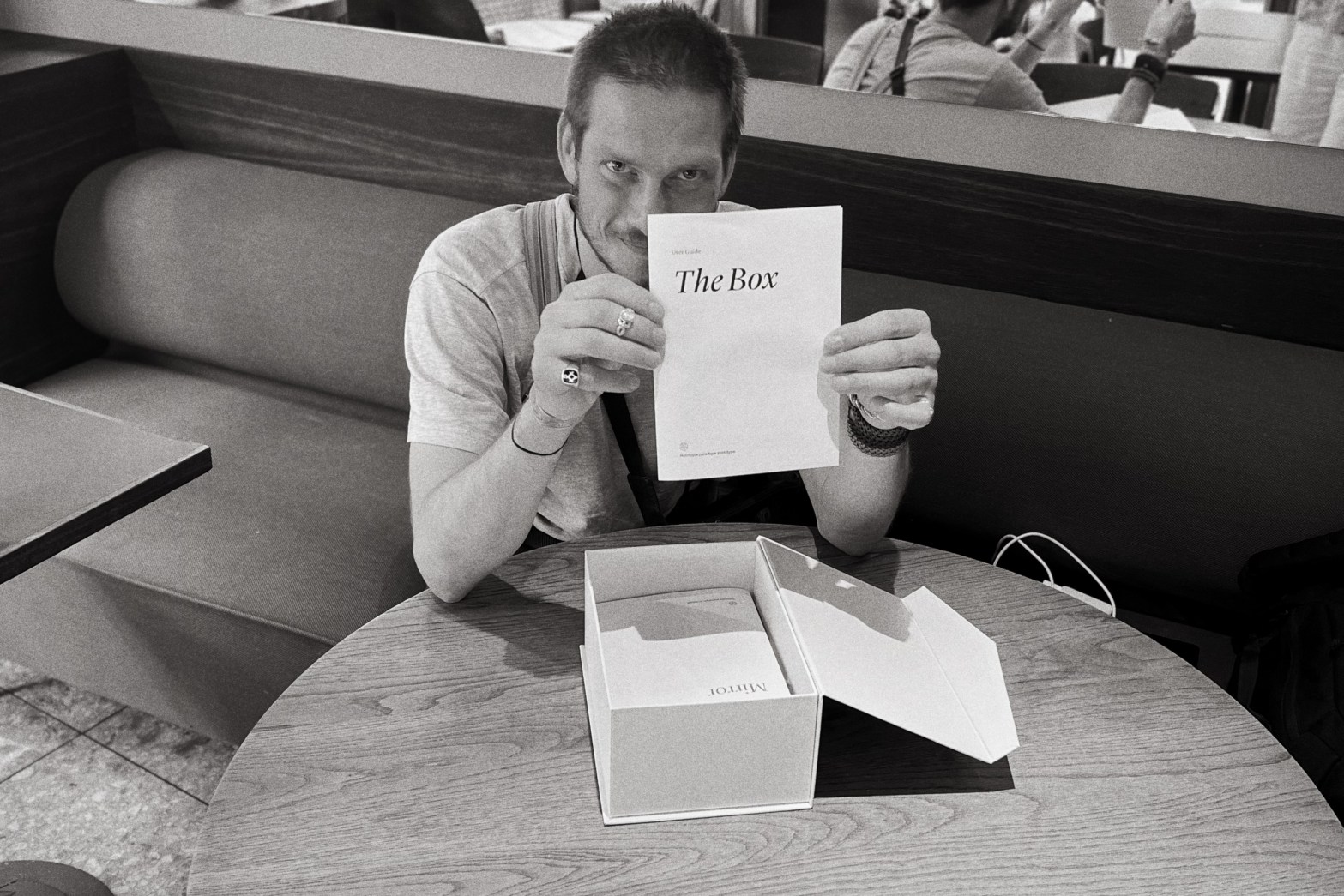
Yesterday at 2 p.m., Fredrik and I completed The Box!
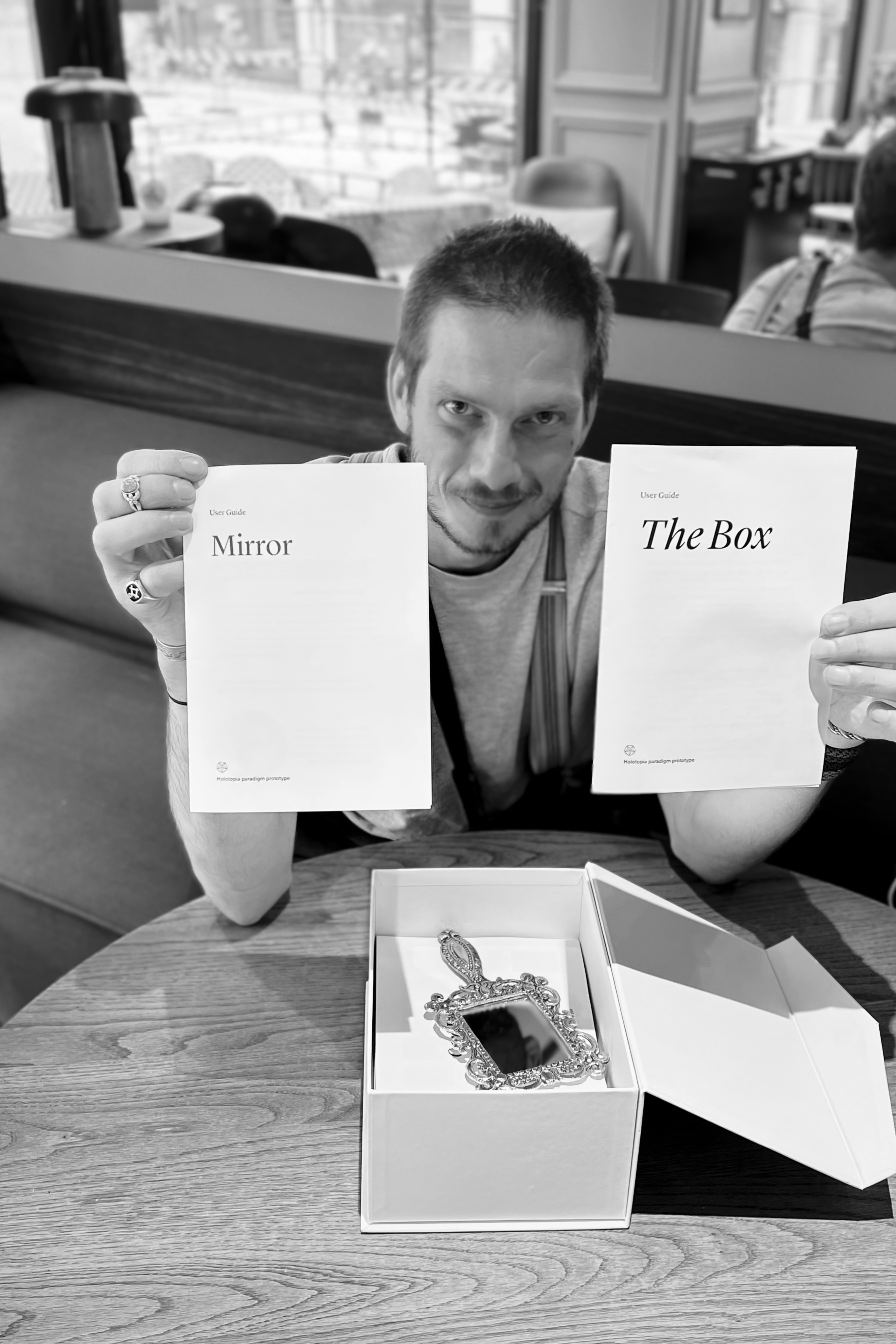
And only minutes later—I was already showing it to Kim, the “global changemaker” icon in the holotopia paradigm prototype.
Let me immediately ensure that I don’t repeat the same mistake. I’ll share the main points, as I explained them to Kim while he was opening The Box. There are actually two points, not one.
The first point is that there are no solutions within the existing world order or paradigm. The paradigm itself is the root cause of our problems (or, more precisely and technically, our problems are emergent properties of the complex system of our society and culture as it has evolved over time, and importantly, of the way it has been evolving).
The second point is that there is no process within the existing paradigm that we can use to change the paradigm. It’s like our stumbling in the dark will end when we create the lightbulb and turn it on; but we are stuck in the wrong process—improving the candle—which can never lead us to the desired end.
The purpose of the holotopia paradigm prototype is to enable us to self-organize and co-create that process—which we call holotopia dialog.
Once a prototype is in place, we can use it to (1) demonstrate that it’s indeed possible to replace candles with lightbulbs and understand the resulting effects; and (2) continuously improve and implement the prototype in practice—and use it to achieve the desired effects.
The objects in The Box “gamify” the process by which the holotopia dialog needs to begin—which we are calling the “liberation dialog”—which is to help us liberate ourselves from (what we might call) the “disciplinary” mindset—where our thought and action are limited by “culture-trammelled understanding”, as Benjamin Lee Whorf called it in “Language, Mind, and Reality”; where we can only think and act as we’ve been taught, only “do our job” within the existing paradigm. The mirror—the first object that appears in The Box—signifies exactly that change, and I’ve been using it in that role here in this blog all along. So let me here focus on the deck of cards—which is a completely new concept.
Here is how we explained how the cards need to be used.
The purpose of this deck of cards is to ‘gamify’ the liberation dialog, enabling us to break free from thought patterns and behaviors that inhibit change. Use the cards to practice connecting the dots, either alone or with a team.
Each card presents an empowering insight.
Choose a card that resonates with you or select one at random. Reflect on it to discern its insight, then deepen your understanding by exploring its Card Keys entry or reading further on your own. Alternatively, arrange the cards solitaire-style on the table and observe how the insights they reveal synergize and form more comprehensive ones.
‘Play’ selected cards in creative projects—and help them achieve their goals.
Each of the five suits delves into a pivotal domain of interest—where high impact can be achieved.
What resources do we possess, and what strategies we should employ—to counterbalance the misguided and entrenched “interests” that propel us all toward disaster? Choose a suit—a path to achieving impact—that resonates with you, then process its cards in sequence, as you might read a comic book.
Use the green suit to reevaluate and redefine the term “green” as it’s been used in politics. Examine why a more audacious strategy—pursuing comprehensive change, both fundamental and structural—holds a much higher chance of success, even if the “solution” to a specific “problem”, such as climate change, is your aim.
Let the color “white” of the white suit remind you of “turning a blank page” and starting anew. Reflect on how the last fundamental and structural change—Enlightenment—unfolded. A sweeping change can occur effortlessly when the foundation upon which our core beliefs have been built is discredited and necessitates a change; use the white suit to explore why that is presently the case—and to consider the necessary steps to streamline fundamental change.
Let the color “black” of the black suit evoke the blackness of ink and the power of words. Enlightenment—a historical fundamental and comprehensive change—replaced “sin” and “salvation” as words that inspired action with “human rights” and “democracy”. Use the black suit to explore ideas that may ignite the next wave of change.
Allow the color “yellow” of the yellow suit to suggest a guiding star, and remind you of the sun shining outside Plato’s cave. Employ the yellow suit to explore how the pursuit of inner wholeness can transform us ethically, culturally, and emotionally, enabling us to handle the powers we’ve acquired with grace and safety.
Let the color “red” of the red suit evoke revolutionary politics and the political “left”—now so deeply disoriented. Use the red suit to explore the novel revolutionary direction we propose.
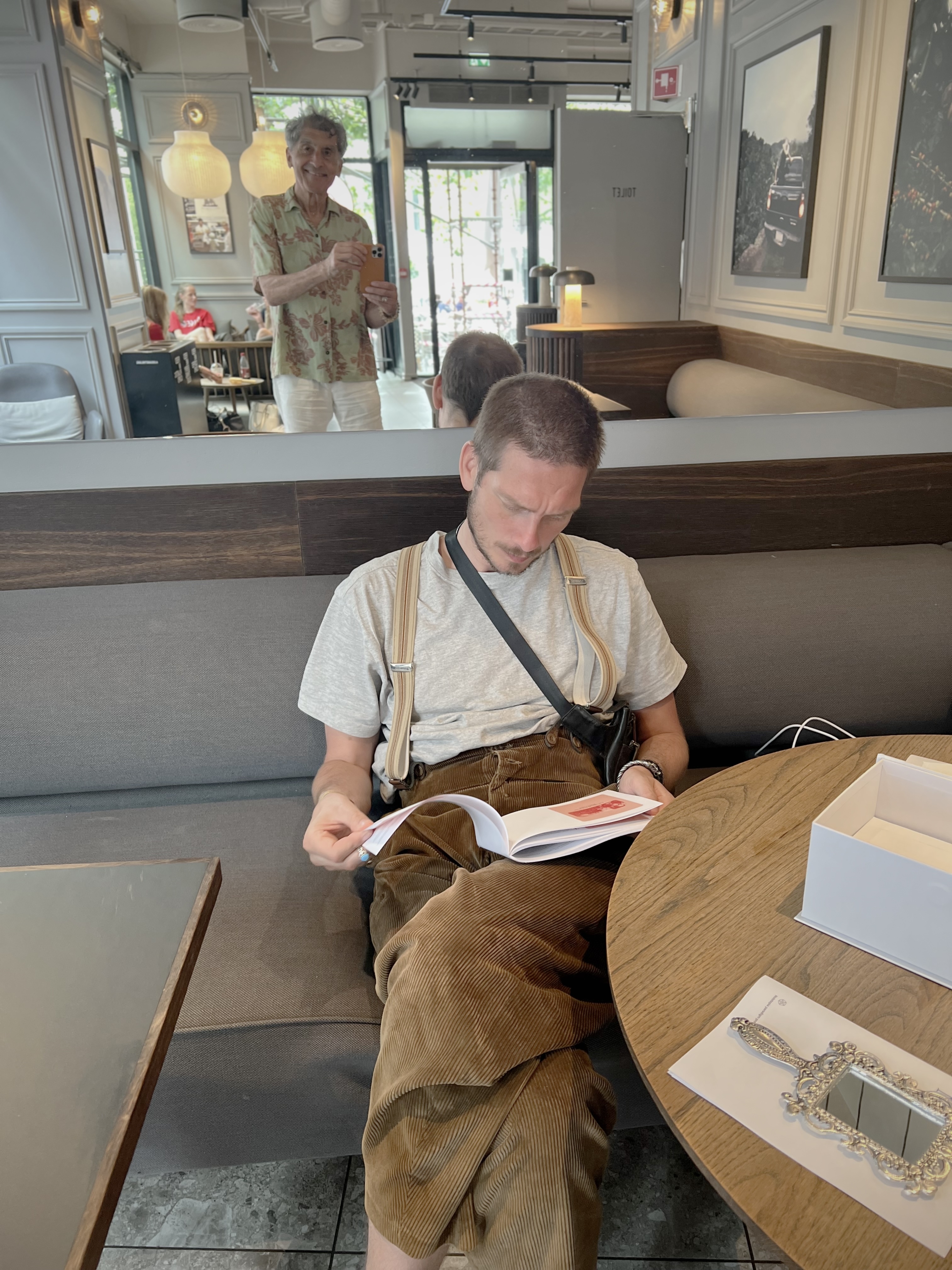
Several years ago, Kim—a successful young entrepreneur—sold his company to focus on making a difference—and created the House of Consciousness, where he and I met. Our initial meeting inspired the creation of the Holotopia in Brief book. Our subsequent and considerably longer meeting helped spark the idea for The Box.
Yesterday afternoon, he and I began this new Unboxing Holotopia series of events—which will be dialogs with real changemakers, utilizing an actual physical box.
 Dino Karabeg's blog