
“If The Club of Rome has any merit”, Aurelio Peccei liked to point out, “it is that of having been the first to rebel against the suicidal ignorance of the human condition.” Now—a half-century after The Club of Rome issued their warning—”sustainability” is a buzzword; does this mean that “suicidal ignorance” is of no concern, that we can put it behind us?
What does “sustainability” truly entail? And how are we progressing in our efforts to achieve it?
I’ll address this in three points. Then, I’ll introduce the Holotopia initiative as a means, or perhaps the effective means, to ensure sustainability is given its due.
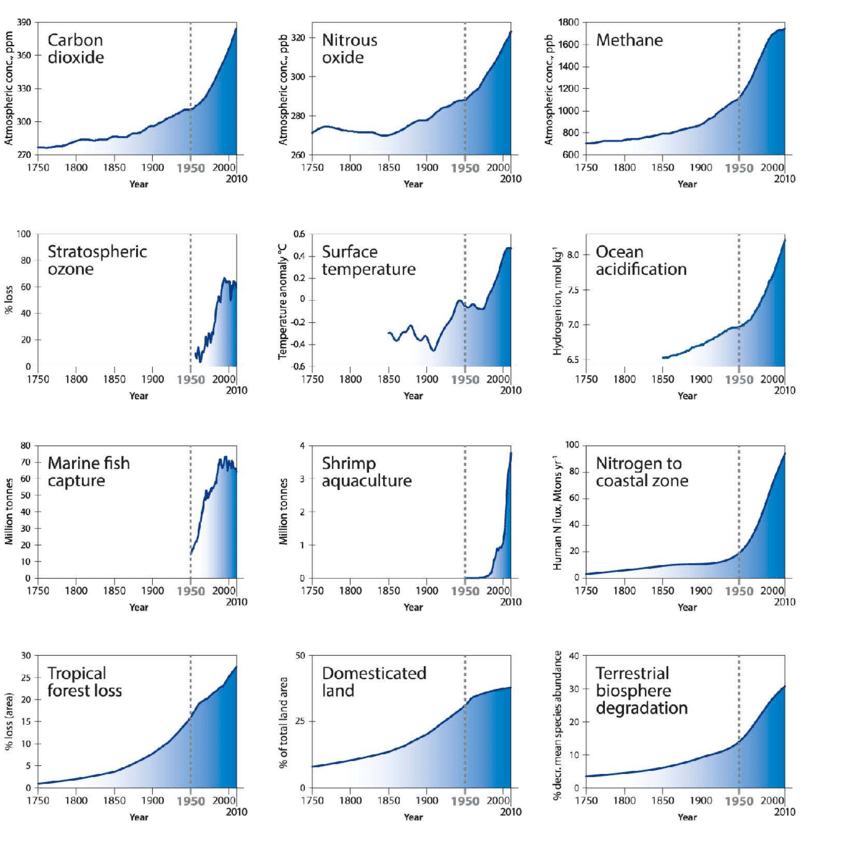
My first point is about the nature of our “development” or growth. Giuseppe Feola provided us with these diagrams that illustrate a significant rise in human impact on the geophysics and biosphere of our planet since 1950.
My second point is to define sustainable growth. For that purpose, I’ll simply paste in this image I found online and used in my 2013 article titled “Bootstrapping Social-Systemic Evolution”.
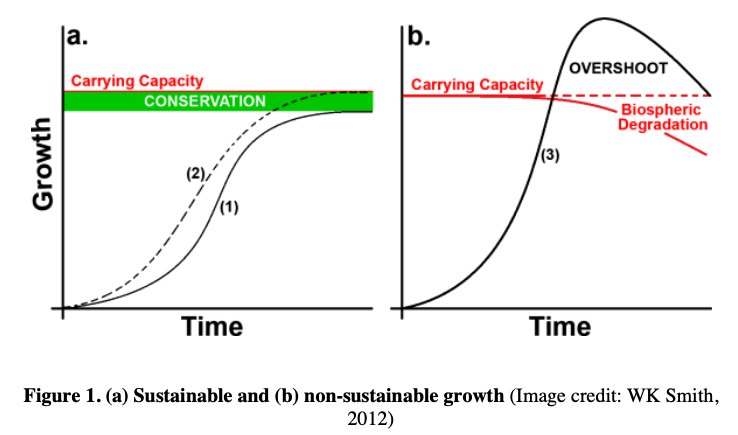
Acknowledging that human variables and their impact do have limits, there are only two ways to reach these limits, as depicted in diagrams a and b. The issue with the “overshooting” scenario b is that it also reduces the limits, or “carrying capacity.”
Let me illustrate this with an example. If all permanent ice on our planet melts due to human-caused climate change, the sea level is projected to rise by approximately 70 meters. If the sea level rises by even one meter, half of the rice fields will be lost because many of them are located in river deltas. Researchers are warning us of “systemic collapse”, where the societal systems we take for granted collapse and collapse one another like falling dominos. For instance, Vietnam might refuse to export rice for any price if it needs it to feed its people. It’s easy to envision how the collapse of the global food market could lead to the collapse of other systems as well.
My previous statements describe our current situation. My third point will explain how the Holotopia initiative aims to transform this situation. Dennis Meadows, who directed The Club of Rome’s MIT project “The Limits to Growth” and co-authored the corresponding book and report, has dedicated a half-century to researching this theme. Let’s hear his perspective on the situation we find ourselves in.
Did you notice how Meadows was searching for words to describe a sustainable alternative, but only came up with “knowledge, learning, music…”? That’s where the Holotopia initiative comes in to make a difference. Here’s how the Holotopia in Brief book begins.

