
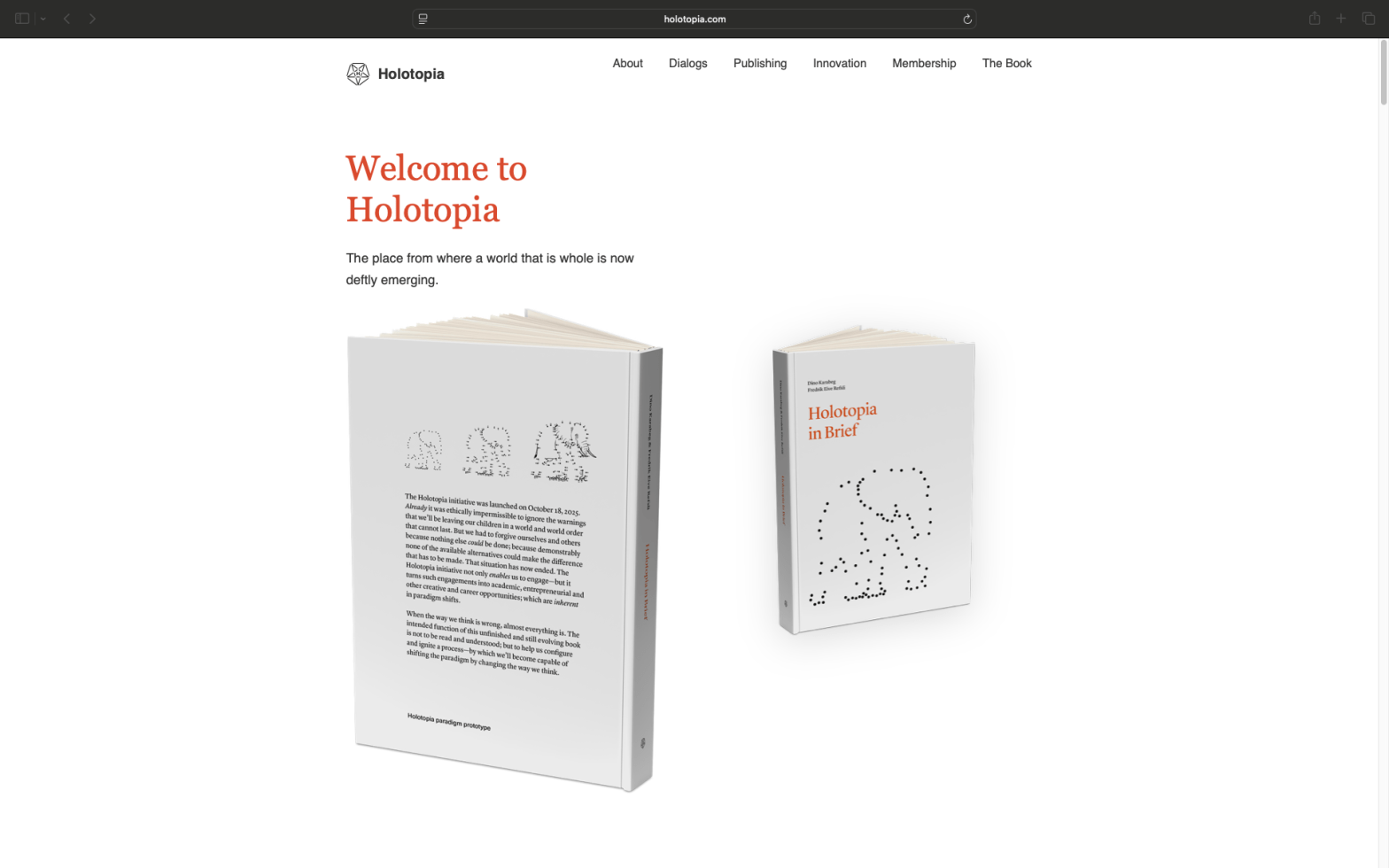
With the Holotopia in Brief book produced and the Holotopia website up and running, the Holotopia initiative has been launched. My thirty years-long hero’s journey has been completed.
A new and different life is about to begin.
What comes next?
How will the Holotopia initiative continue to unfold? I think Fredrik and I did a thorough job emphasizing that “the intended function of this unfinished and still evolving book is not to be read and understood; but to help us configure and ignite a process….” There can hardly be any doubt that a process is the point of it all; that we are inviting our readers, that we are inviting you to foster a process with us together. And yet when I close my eyes and imagine you (or anyone else) reading the book, I imagine that you’ll close it, perhaps agree with some of the things and disagree with others, and then eat a dinner; and watch a movie… I imagine, in other words, that you’ll ignore our call to action, to join us in creating a new process. Or to use our usual keyword, I imagine that habitus (the compendium of habitual processes, amplified and calcified by the stress and strife and the attractions and distractions of modern living) will once again—and every time again—take over and get the better of us. I am imagining this because my three decades of experience confirmed it with stupefying consistency.
Can you and I do better? Can you help me break this spell?
Let’s perform an experiment: I’ll attempt to guide you to the beginning of the process we are inviting you to ignite together, in three simple and easy steps; and ask you to observe your thoughts and feelings (which is key to the dialog, as David Bohm envisioned it; by which the grip of habitus is to be broken). If this helps you free yourself from the spell and join the process, we’ll call this a success; and if it doesn’t, you’ll be able to help me see what went wrong and how to do this better next time.
In either case we’ll make the key next step toward holotopia’s unfolding.
We, contemporary human beings, are accomplices in a crime more atrocious than any in human history; which is likely to be the end of that history and bring unthinkable suffering and hopelessness to everyone on earth; for this to happen, reportedly, no more is needed than us continuing to think and live as we do. This blog’s About article opens by quoting Russell and Einstein warning us that that’s where we are headed (unless we “learn to think in a new way”); the Holotopia in Brief book opens by quoting Margaret Mead; its Chapter One opens by quoting Aurelio Peccei; all said roughly the same thing. Notice that we are deliberately quoting the diagnoses and calls to action that are a half-century old; to point out that they have been ignored.
So here’s my point number one: In the plethora of processes that constitute modern living we do not have a process by which we could effectively answer to those calls to action, and “change course”.
It is that process we are inviting you to co-create and be part of.
Academic communication—or writing and reading in general—does not constitute that process.
Let me dramatize also that point: Imagine all those wonderfully smart and knowledgeable people, historical and living, whose ideas have been recorded in books; some of them must have contributed some useful clues about how to change course. (I have an example in mind—Henri Bergson; finally I am reading him systematically. What a man! If what he wrote, a century ago, were communicated—this world would surely not be the same.) Imagine if the process by which we (try to) communicate has a radically better alternative. Could the insights of smart and knowledgeable people, historical and living, just be going to waste—because the process we are using to render them useful is not working?
Here is the second point I submit to your consideration: Instead of adhering to its own habitus (academic publishing)—the academy (the institutionalized academic tradition; which is now standard at schools and universities worldwide) would do better to reconsider the process it is using.
Step three may seem a touch forward; but this is an experiment, so please bear with it.
I invite you to imagine the following resolution of our civilization’s evolutionary deadlock: The academic people take a careful look at what the Academy’s founder wrote; and an epiphany results and the world changes.
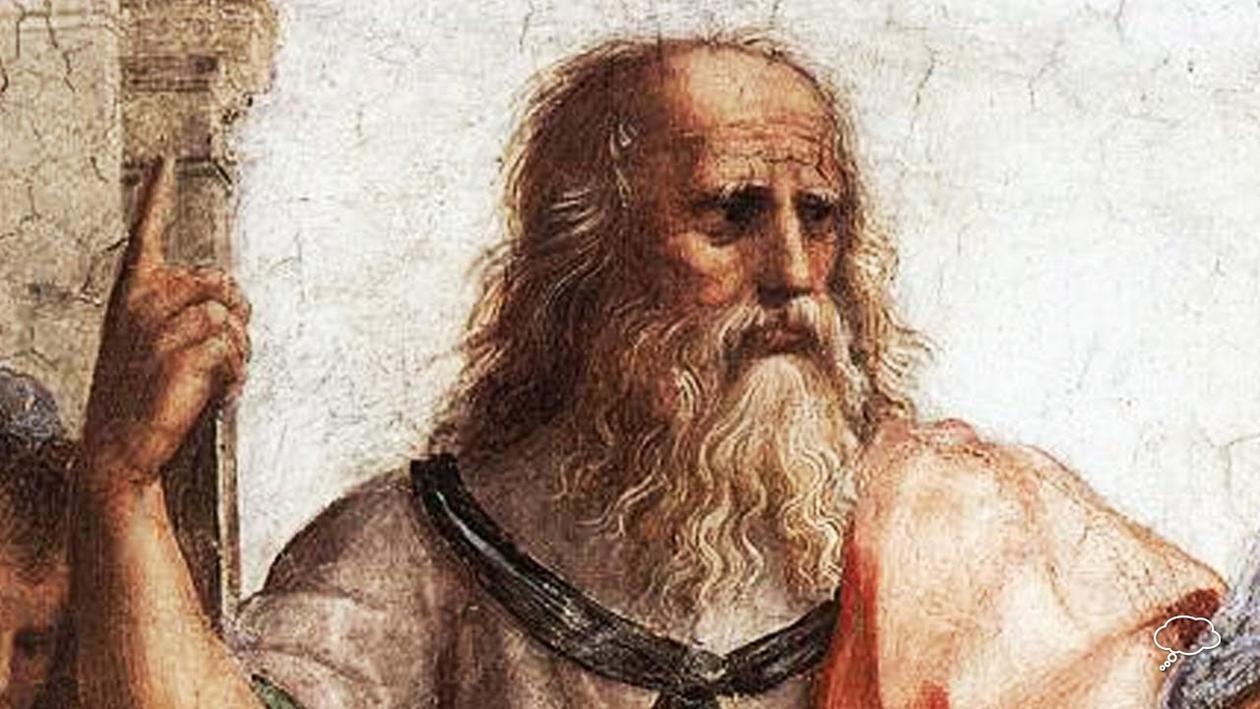
Famously, Plato pointed upward; and asked us to create and use general and abstract ideas to comprehend the complex and messy “reality”; and to orient ethical and other choices.
The information we have—academic and the one given to us for daily use—is flagrantly not the sort of thing that could possibly enable us to do that.
You’ll now easily comprehend what my “hero’s journey” or deep creative process was about; and what resulted.
Those thirty years were divided roughly equally between two projects:
- The creation of a transdisciplinary methodology (“scientific method” that enables us to create general ideas about any theme that matters), and the development of its proof-of-concept applications and consequences
- The creation of the knowledge federation transdiscipline as a system capable of creating (technology-enabled social processes for fostering) general ideas and ideals, and the development (with the Knowledge Federation international R&D community and our collaborators) of suitable proof-of-concept prototypes.
Together, those two things constitute the holoscope—(a prototype of) a corrected way to see and comprehend the world. When you look through the holoscope, you say (the way to) holotopia.
Toward the end of this period, for several years, I withdrew from productive work to configure and present (what we now call) the holotopia paradigm prototype as a coherent system; and to plan its practical deployment toward growth and impact.
About a year ago I concluded that this was completed. An opportunity presented itself to do the next step (ignite the process) in Zagreb—which completely failed. I realized that our pre-communication was inadequate; and endeavored to turn the materials that Fredrik and I created for Zagreb into blog posts; and to turn this blog into a runway for launching future dialogs.
I can say, in hindsight, that my own process was the stumbling block. Having been trained as a theoretical scientist, and by some excellent people (in systems science and algorithm theory, says Holotopia in Brief) I had just the right mindset to see what was (systemically) lacking and to envision and produce (a prototype of) a remedial process. But I was trained not to make any claims before their proof was spelled out coherently and completely. So it’s fair to say, looking back, that my own inability to call things by their names was preventing me from hitting the bull’s eye.
Finally, about three months ago, several tings came together: I realized that a clear and coherent system of things and ideas had been completed, and with it also the need for my retreat; I did not need to do so many sketches on paper, my formulations were clear, the words flowed… Then Fredrik was applying for the full professor position at his university; reading his application, I realized that his comprehension and communication too had matured.
October 18 was the date for Noah’s “confirmation” (Norwegian-traditional ritual stepping into adulthood); my brother Erol and his wife Maja were coming from California to take part in it; they’ve been advising me to switch to the “agile” approach, which is now common in software development (in which they work and own a company); where you don’t wait until things are perfect (they never are)—but improve them through use, together with your clients. So I proposed to Fredrik to see if we could produce a whole new book (prototype) within three months. Which we did. Then we had an extra week, while the book was being printed, and we thought let’s create a website too.
Here it is—the Holotopia website. The book you may read only in its traditional, printed paper form.
Can we be, can we become that “small group of thoughtful, committed citizens” that allegedly can “change the world”? The difficulty we are facing is to break the spell of habitus.
The opportunity we are facing is to co-create the process and be the process whereby the difference that makes a difference is made.
 Dino Karabeg's blog