An ecosophy…integrates the efforts of…a team comprising not only scientists from an extreme variety of disciplines, but also students of politics and active policy-makers.
– Arne Næss
If you’ve seen this blog’s About article, you’ll know (that Russell and Einstein told us) that we have to learn to think in a new way.
That’s what the word ecosophy in the title—and in the rest of this article—stands for.
Arne Næss coined it to point to a creative challenge: To rescue our planetary oikos from destruction and to make it last—we have to make rapid and radical progress in themes that are, traditionally, in the domain of philosophy. But philosophy—as it is practiced in our academic departments—is flagrantly inadequate for the task at hand (changing the way we the people think; and reconfiguring the values we uphold; and providing us guidance in this time of need).
Indeed—if you take a look at Arne’s seminal 1973 article, from which I quoted the above excerpt—you’ll see that (Arne claimed that) an ecosophy has to be a transdiscipline!
And if you’ve also seen We MUST Learn to Think in a New Way, you are aware of the challenge that Descartes left us:
To find a way to truth that is universal; to create a science that empowers the mind to make solid and true judgment about any theme that demands attention.
So that’s what you and I are about to do. I’ll propose a prototype solution; and invite you to examine it.
So that together we may begin to constitute a process—by which we’ll empower (first ourselves, and then our students and children or) our next generation to think in a new way.
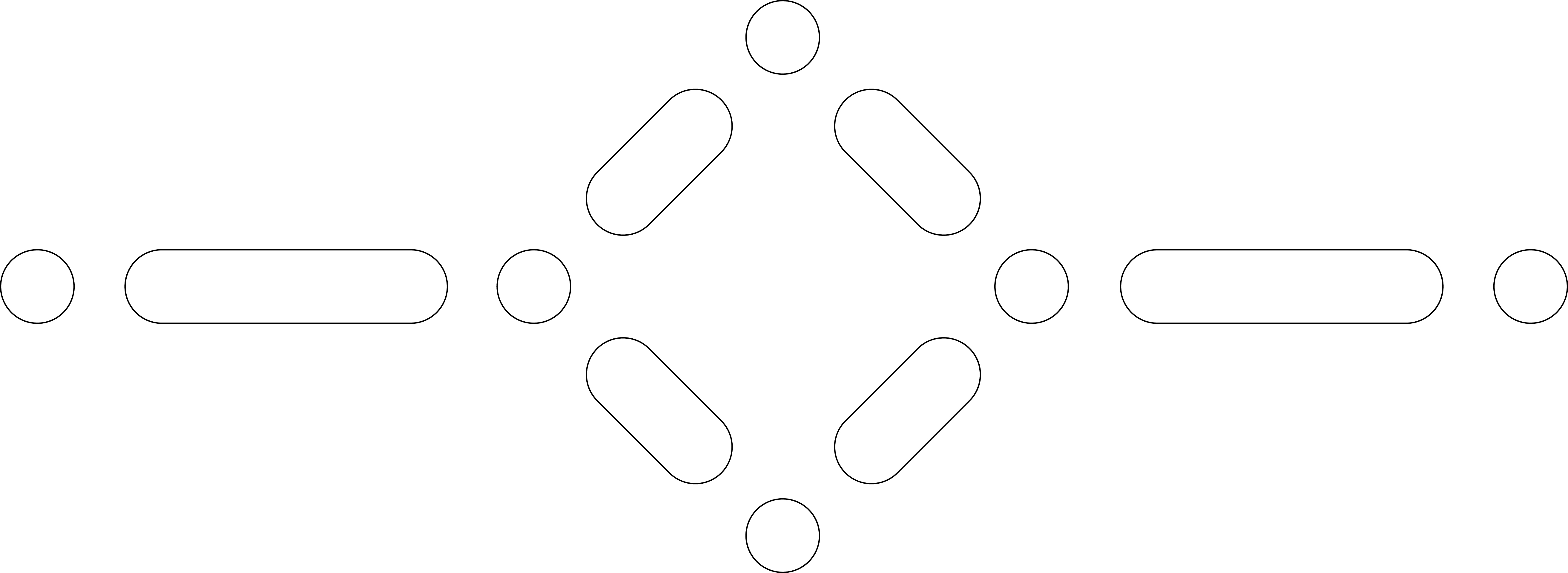
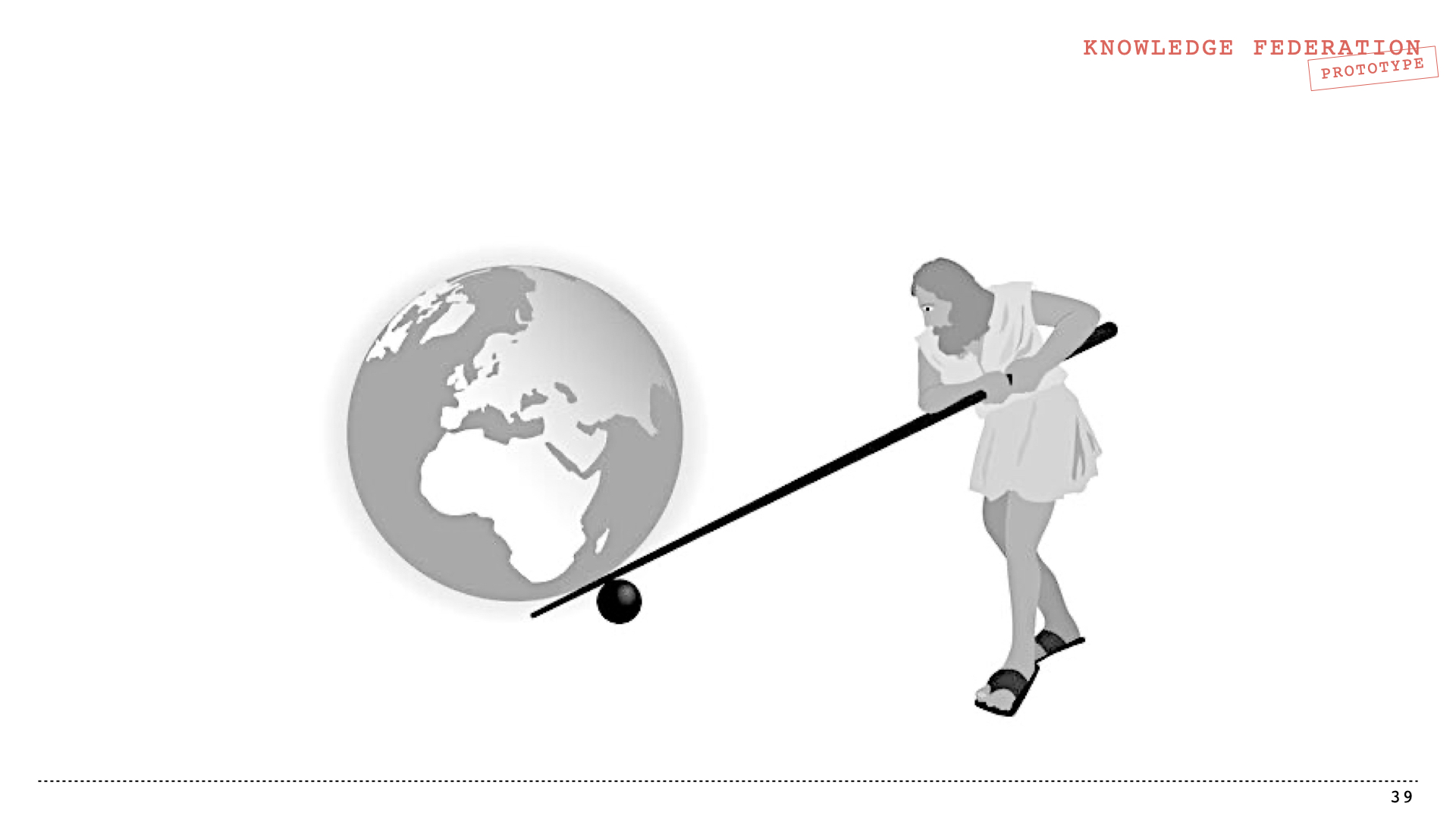
“Give me a firm place to stand on, and with a lever I shall move the Earth.”
Attributed to Archimedes, this bold proclamation has been used as a parable for the power that science and technology have given us. Now that we need a different power—to move ethic and culture from a standstill, and be able to direct the power that science and technology have given us—what new firm place to stand on can we find?
I offer you knowledge federation as a prototype answer.
I use this keyword to point to two different things—and let you see from the context which of them I mean.
Knowledge federation is (proposed here as) a new way to truth.
It’s, roughly speaking, what consulting the Scripture was to our not so distant ancestors; and what “logical thinking” still is to so many of us today.
Knowledge federation is also the name of a prototype.
Which I’ll offer you here as a prototype of the very thing that’s now urgently and vitally needed—an ecosophy.
A Novel Way to Truth
If we can’t trust even our own minds to guide us to truth—then what in the world can we rely on?
As I said—I offer you knowledge federation as a prototype answer. Here is how I explained this in the Holotopia book manuscript.
Together, knowledge federation and truth by convention constitute what Descartes was seeking for with so much passion—a new Archimedean point; an unrestrained and unshakably solid way to truth.
Here is how I introduced truth by convention in the Holotopia book manuscript.
Truth by convention is like the definition in mathematics—incontestable.
As you have just seen—Quine singled it out as the sign of maturing that the sciences undergo in their evolution.
So why not use it in our pursuit of truth in general?
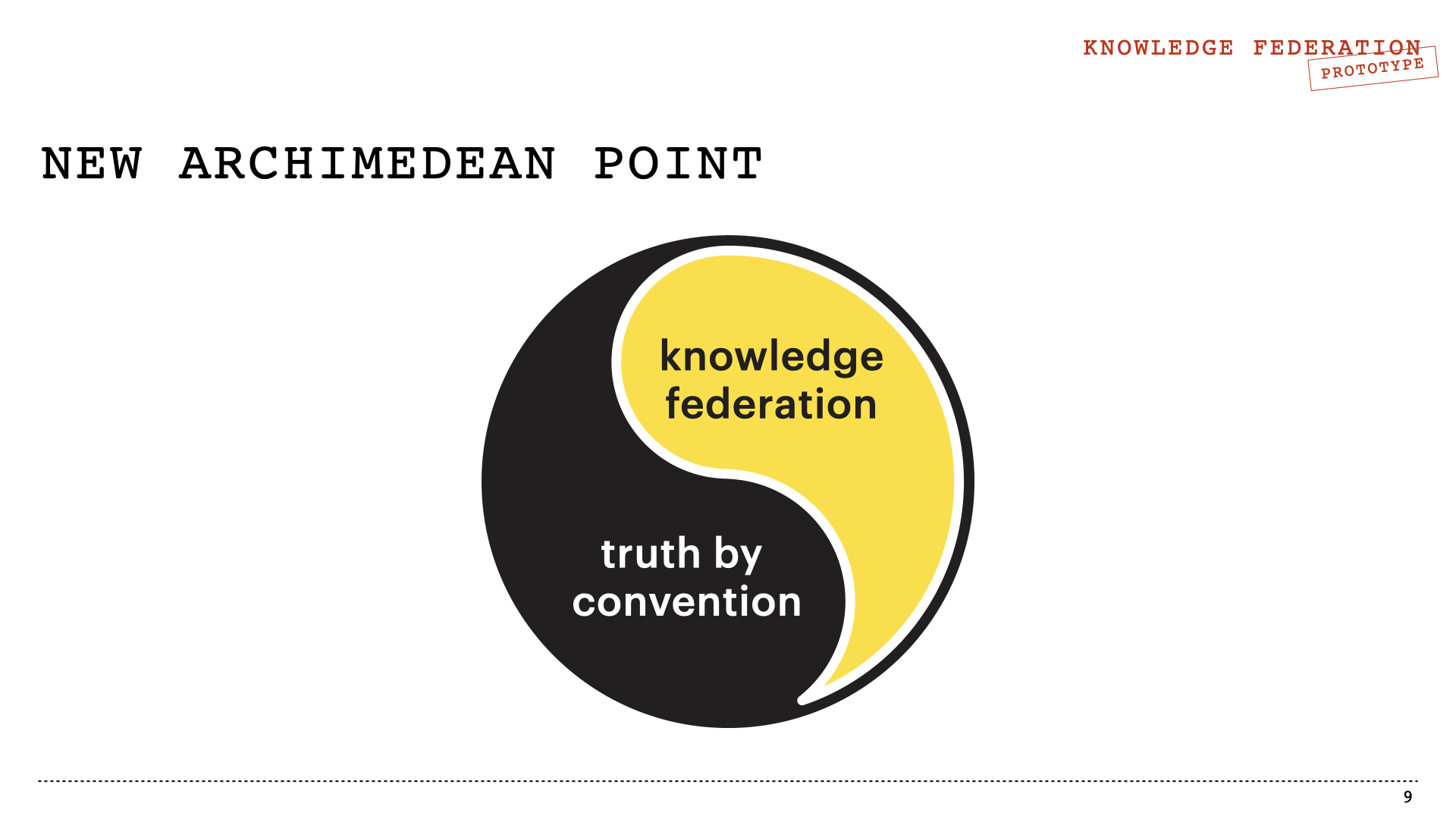
Like yin and yang in Chinese cosmology, truth by convention and knowledge federation provide the solid and the active principle to truth creation. And like yin and yang—they co-create one another.
Knowledge federation is founded on truth by convention (the knowledge federation axiom is a convention); while truth by convention is federated (from Villard Van Orman Quine).
We can use truth by convention to redefine anything—including “truth” itself!
So let’s define truth (no longer as something “objectively” pre-existing, which we can or have to “discover”, but) as creditability; by making a convention. This will empower us to treat (the way to) truth as any other human-made thing—and adapt it to the functions it needs to serve; by federating pertinent evidence.
And creating transdisciplinary science.
As I said—I am here only prototyping, only highlighting; aiming to model and ignite a process by which we’ll create the real thing together. So here is my prototype answer; where Einstein is in the role of an icon—for contemporary science; and the new fundamental findings it produced.
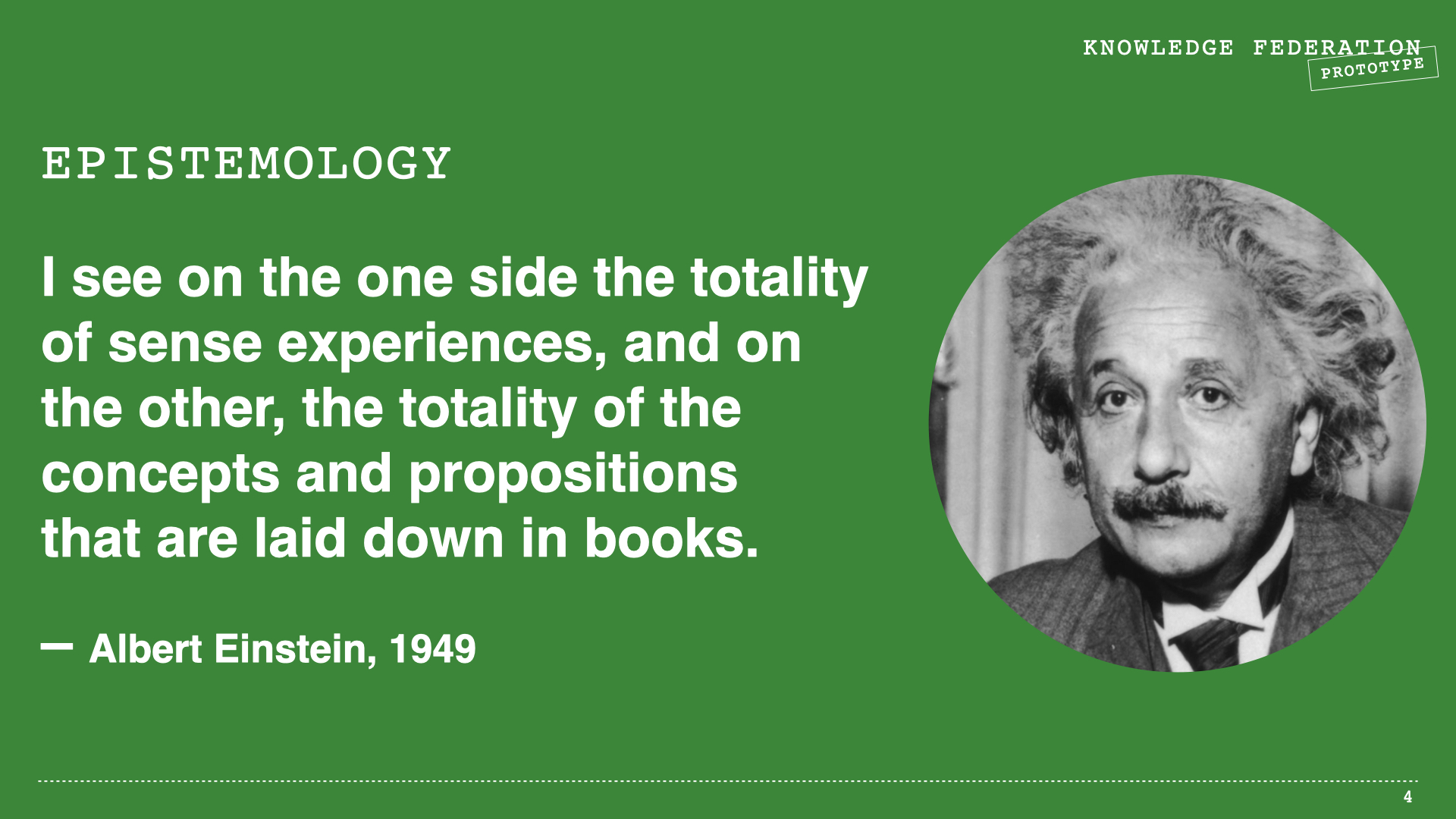
The transdisciplinarity ideogram depicts transdisciplinary science as it’s been modeled within the knowledge federation prototype.
Where you see the realm of experiences or the so-called “real world” on the one side; and the realm of ideas on the other.
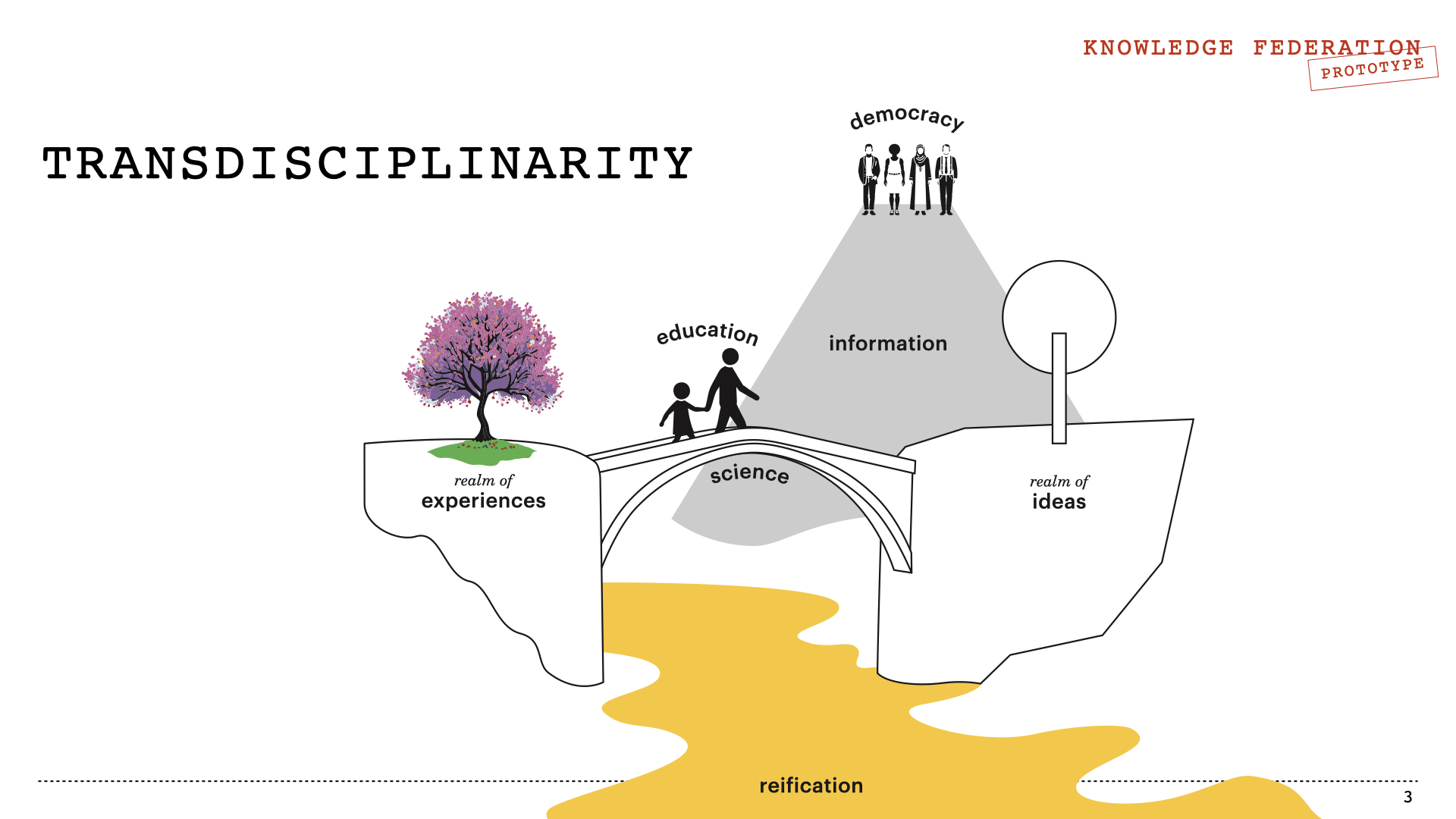
“The system of concepts is a creation of man,” Einstein continued, “together with the rules of syntax, which constitute the structure of the conceptual system.…All concepts, even those closest to experience, are from the point of view of logic freely chosen posits, just as is the concept of causality, which was the point of departure for [scientific] inquiry in the first place.”
Here is how (this proposed prototype of) transdisciplinary science operates.
We choose any theme in the realm of experiences—but preferably the one that is the ‘biggest issue’ out there, and calls for attention (we may climb to the top of the metaphorical mountain in transdisciplinarity ideogram‘s background to make that choice).
So let’s say that we chose “information”!
We may now walk with “information” over the transdisciplinary science bridge to the realm of ideas—and define information, by making a convention. I told you about the choice I made in the About article.
We’ll consider information as the guiding light, or metaphorically—as the ‘headlights’ of the (modernity) ‘bus’ in which we ride into the future.
That’s all we need for now. We can now federate whatever is relevant to information in the realm of experiences; and combine it with what is known about related and relevant ideas in the realm of ideas.
In what way may information need to be different?

Here’s an expert opinion: Neil Postman told us, from the point of view of “media ecology”, which he established academically, that the information we have is not only failing to make the world manageable and comprehensible—but indeed immersing us and our minds in a destructive ecology; which imperils our very ability to comprehend.
Not a good starting point if we are to be able to use information to see and steer a new course.
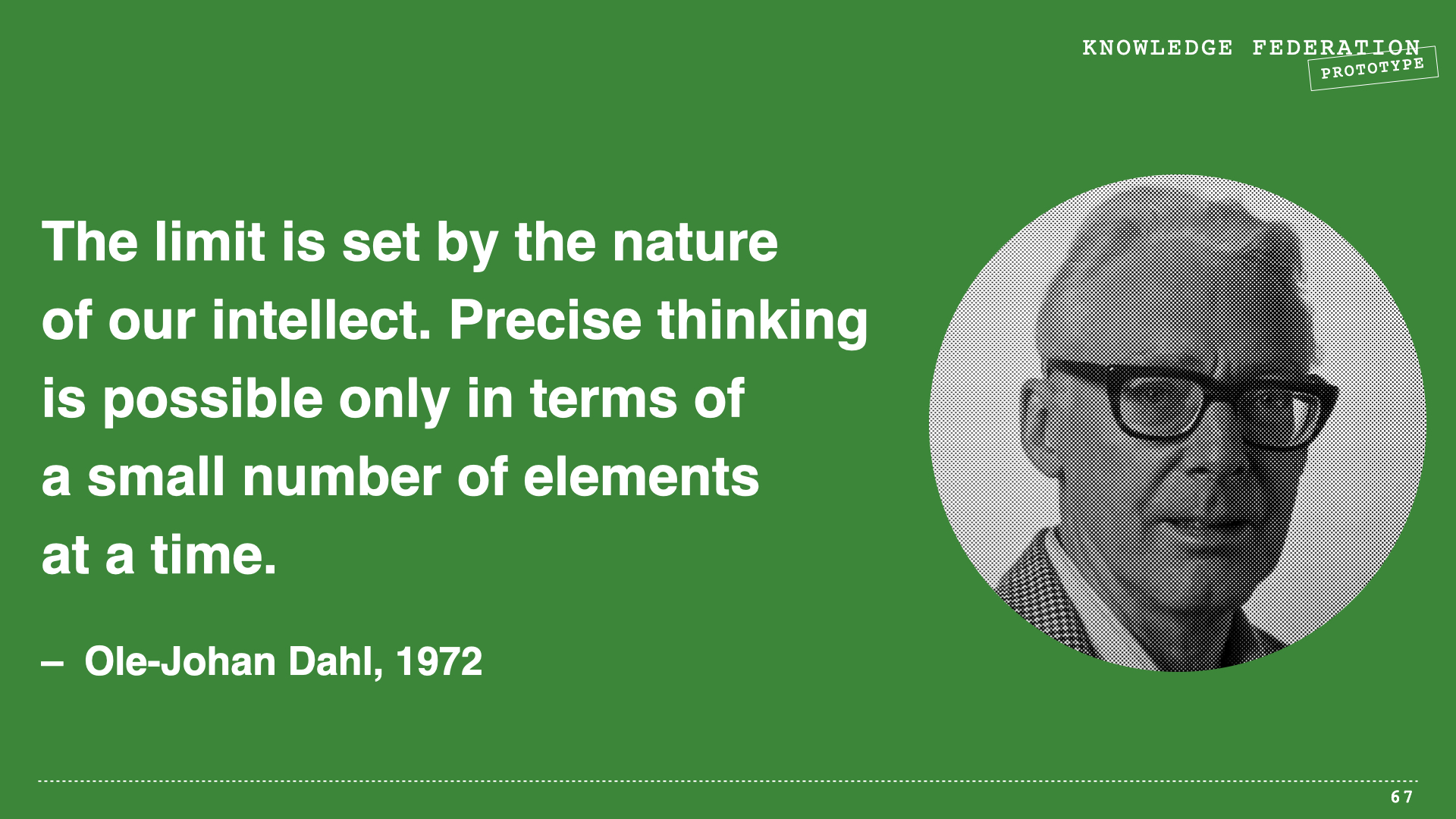
Here’s another expert opinion: Ole-Johan Dahl told us that we have to use abstraction; that our minds can only deal with “a small number of elements at a time”.
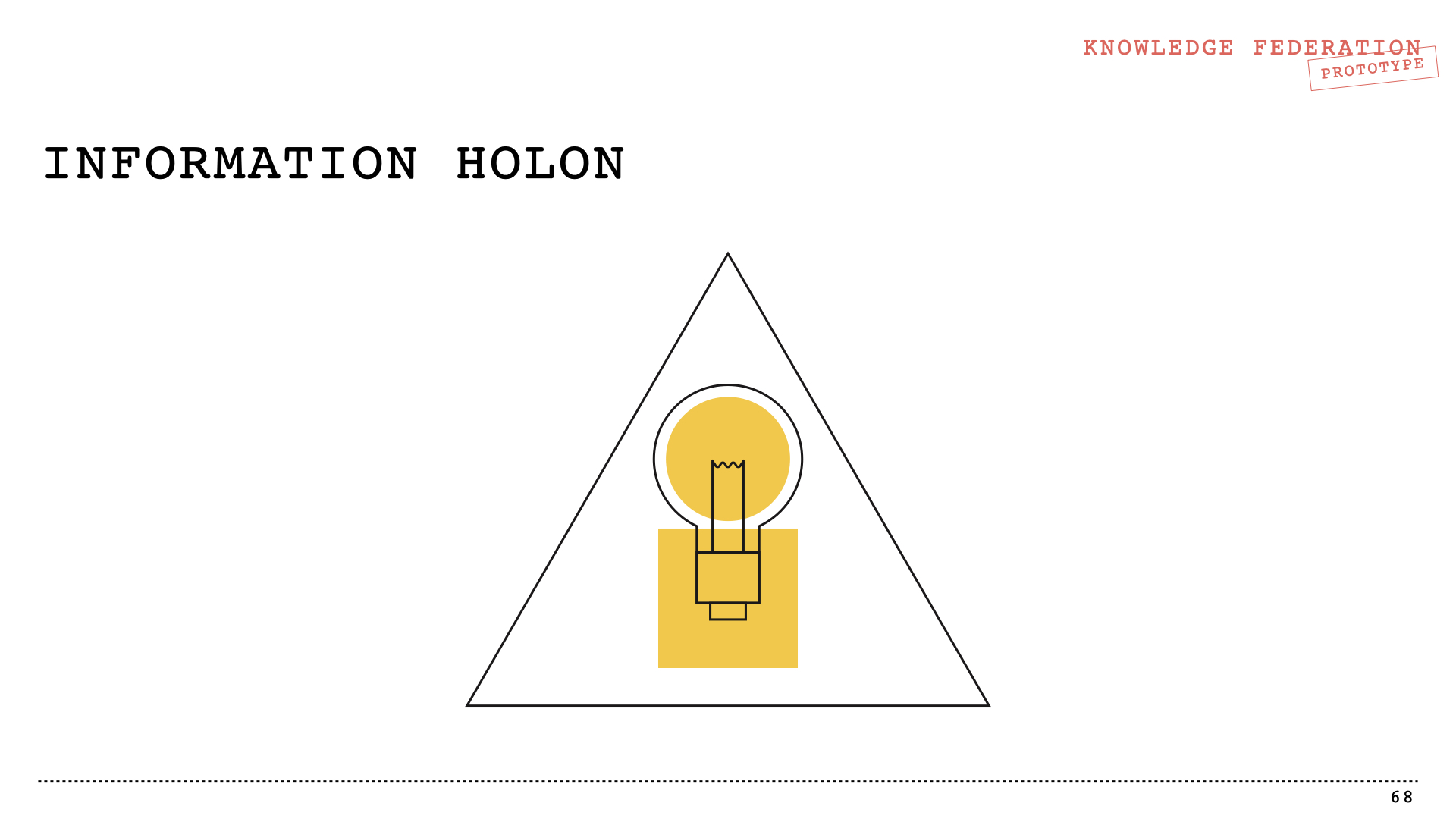
As I said—this is only a quick and rough summary of a comprehensive prototype; whose function is no more than to ignite a dialog. So here’s how information (that is produced by transdisciplinary science) is depicted in that prototype. Think of the triangle as representing a hierarchy of viewpoints and view, or the metaphorical mountain; and of information (represented by the “i”) as composed of a circle on top of a square. And let the square stand for all the detailed data, assembled from all sides; and let the circle represent the point of it all.
And you’ll already have a pretty good idea of how transdisciplinary science has to operate!
We can now create methods for sorting out the “the information jungle” and making sense of things; or metaphorically, for putting together a square (related to a chosen theme)—and turning it into a circle (a general, guiding insight).
Naturally, we’ll base this procedure on “the scientific method”.
I’ll give you a hint.
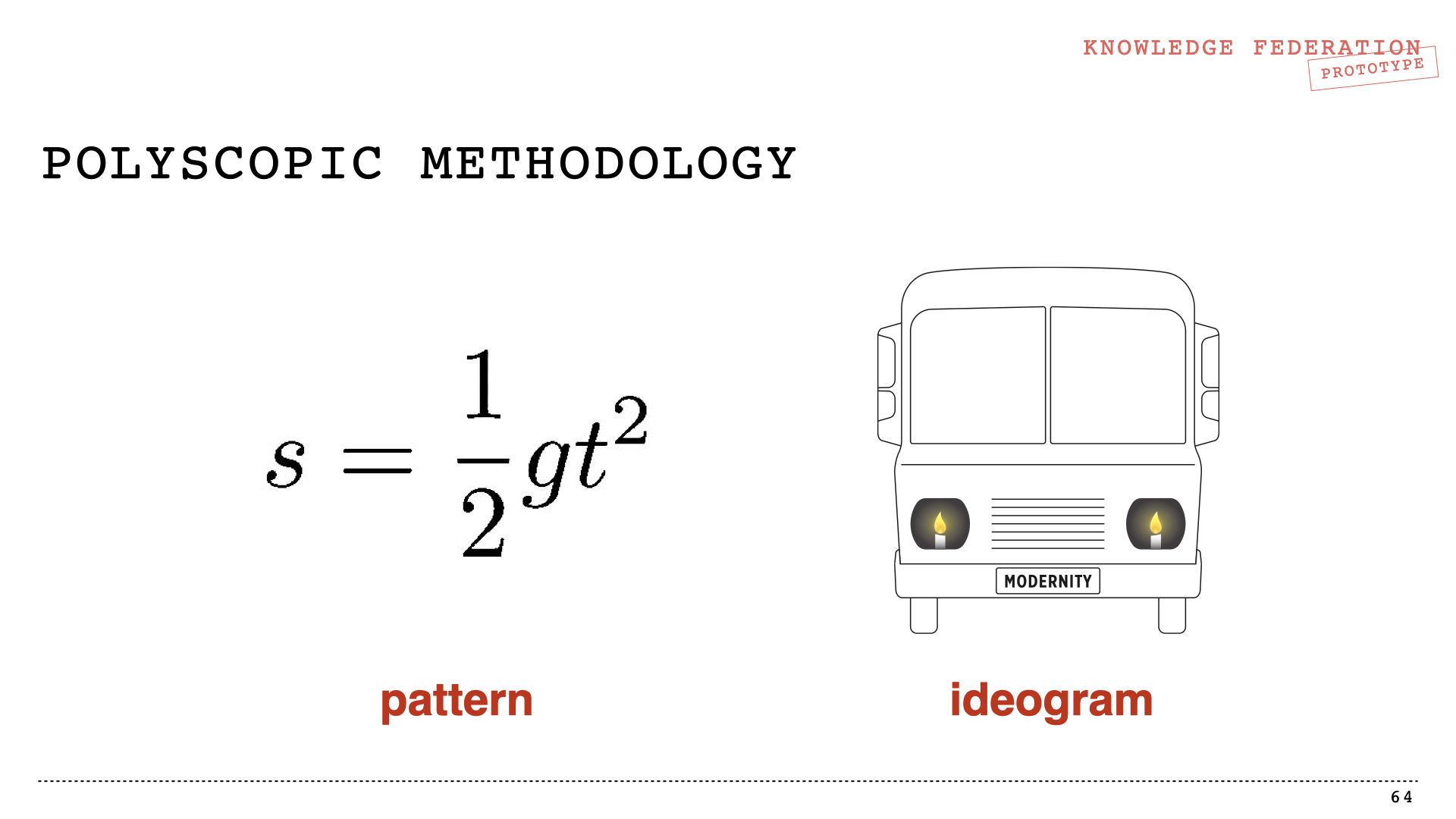
In polyscopic methodology (the generalization of “the scientific method”, which is provided within the knowledge federation prototype) we use patterns (defined as “abstract relationships”) instead of maths (mathematical functions are, indeed, patterns of a certain limited kind).
And we represent patterns by ideograms.
The modernity ideogram can now be understood as representing a pattern; which posits a claim (that continuing to use the information we’ve inherited from the past in its new and vitally important pivotal role would be just as perilous and headless as using a pair of candles as headlights in a bus).
This can now be turned into a result (or circle, or insight).
The results of traditional sciences acquire creditability in two ways:
- By experiments—which are “repeatable” and hence verifiable
- By theoretical arguments—which are verifiable by checking the ‘maths’.
The results in transdisciplinary science (as it is modeled by the knowledge federation prototype) can be created—with creditability—by referring to experience or by rational arguments that involved ideas. The experiences appear in this process as eye witnesses; reasoning arguments are made precise and convincing by defining the concepts and their relationships in a suitable way.
No “reality” claims are made.
Both the methodology and its results are prototypes—the best available current versions; subject to indefinite improvement. The rationale here is that we necessitate information; that we depend on giving creditable answers to pivotal questions.
So we just do that as well as we can.
And continue to improve both the answers and the processes we use to create them.
Truth as an Ethical Category
It was an interesting coincidence that our Knowledge Federation as Ecosophy dialog in Zagreb was organized at the faculty of an academic excellence center for ethics.
We shared this flyer with our local organizer, to invite the participants.
As I explained in the About articles—the prototypes here are not only models, but also interventions; and importantly—also experiments.
Which tell us what works well, and what needs to be improved.
The results of our Zagreb experiment are documented in this photo.
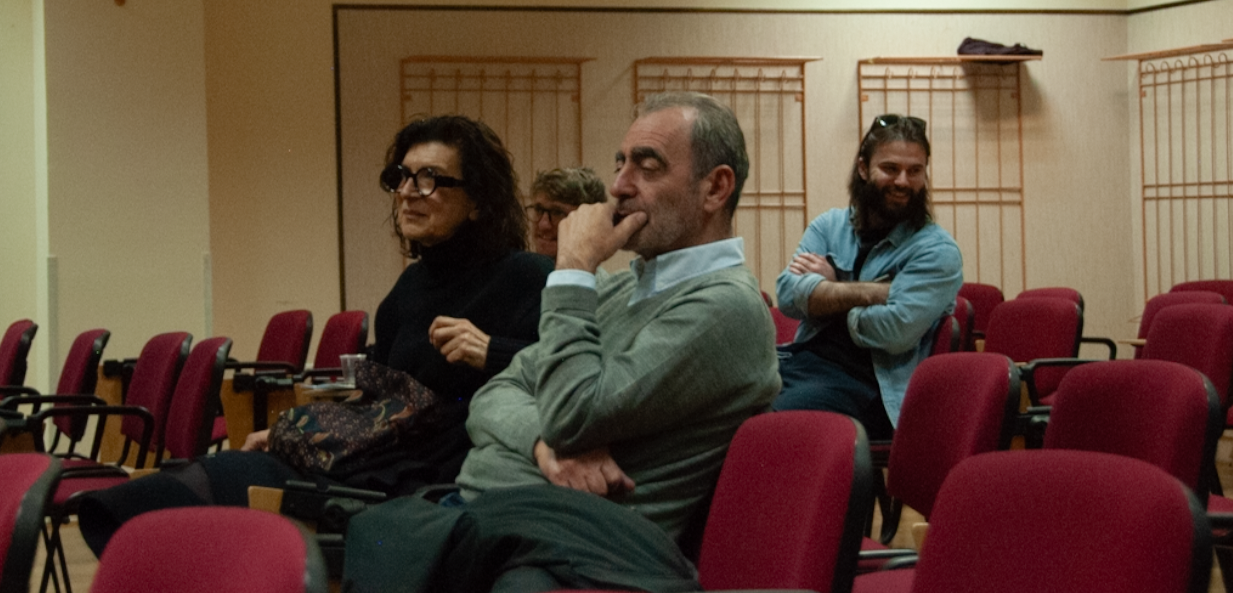
These two people you see in the foreground are my old friends Đenana and Erol. Our local organizer was a graduate student.
Not a single member of this institute’s faculty showed up.
I rush to make it clear that this is not a complaint about this institute’s faculty.
I showed you the above photo to point to a general pattern.
Which has repeated itself in all our attempts to update the academic system—with stupefying 100% consistency!
And not only in our attempts.
Everyone I am aware of—who attempted significant change—faced the same obstacle.
Aurelio Peccei (who, as I pointed out in the About article, here iconizes the change makers) summed up in The Human Quality:
The real problem of the human species, at this stage of its evolution, is that it has not been able culturally to keep pace with, and thus fully adjust to, the changed realities which it itself has brought about in this universe. Since the problem at this crucial stage is within, not outside of, the human being, individually and collectively, the solution must also come primarily and fundamentally from within.
The question is, then, one of human quality [sic], and how this can be improved.
The challenge we are facing (to learn to think in a new way, to be able to re-create our world) is a paradox.
Here is how I attempted to portray it in the Holotopia manuscript.
If moral philosophy is expected to be the modernity‘s road to good morals, and if moral philosophers are expected to create moral philosophy for everyone who doesn’t do it himself—then this question may be asked:
Who creates moral philosophy for moral philosophers?
This joke question becomes serious and relevant if we consider “moral philosophy” as the system that moral philosophers use to do their job; to give sustainable ethical guidelines to us all.
How suitable is the system of moral philosophy for its function?
I found this in the Britannica:
A crucial question of normative ethics is whether actions are to be judged right or wrong solely on the basis of their consequences…The debate between consequentialist and deontological theories has led to the development of a number of rival views in both camps.
See what I’m telling you?
Moral philosophers cannot even convince each other!
Buckminster Fuller warned us:
You never change things by fighting the existing reality. To change something, build a new model that makes the existing model obsolete.
In Transdisciplinarity Is the Way to Change Course I will demonstrate that the “new model” I have just outlined does empower us to bring forth a remedial or ecosophical ethics.
 Dino Karabeg's blog